|
It was that sort of day where the sky
hung like a damp tea towel, grey and limp, and the sun, when it
bothered to make an appearance, shone a pale, dull northern light
on the faces of the three restless grammar schoolboys.
"Wanna skip off…? " Dougie nudged Joey, his accent
thick as treacle. "No one's down there now…builders have
gone home." He jerked his head towards the wire fence separating
the school rugby field from the new council flats rising on the
steep slope beyond. Smithy, the smirk of a ringleader on his face,
was already squeezing his wiry frame through the torn mesh.
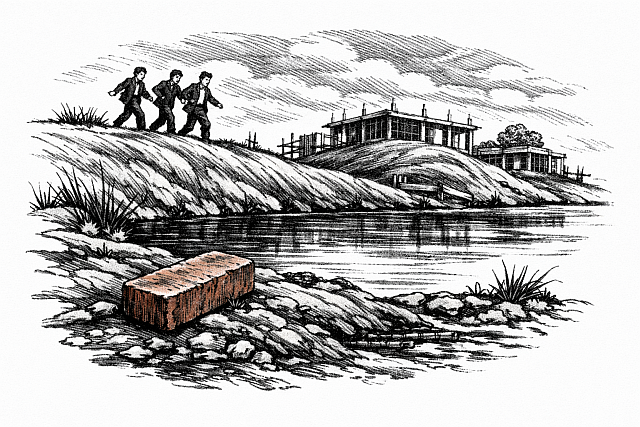
The hillside was a maze of mud footing trenches and half-built walls.
Red housebricks lay dumped into piles, hods abandoned, ready for
the next shift of brickies.
As a steady rain trickled down to the muddy retention pond, shimmering
dark and inscrutable at the foot of the hill, Dougie snatched up
a roof slate, grasping at its slick surface. "Bet I can skim
this across!" he crowed. Joey watched, uneasy, getting ready
to duck as Dougie's arm swung back. The slate spun and arced before
slapping the water with a staccato of dull thuds. "Rubbish!"
Smithy laughed, grabbing a housebrick. "Watch this!"
Smithy's throw was wilder, fiercer. The brick slipped sideways out
of his wet fingers, cracking with a thud into the back of Joey's
head. Arms windmilling, he lurched forward into the waiting depths.
He didn't recall the fall, only the cold, dank water engulfing him.
Everything went silent. Darkness swallowed him. The cold pond water
shocked him into consciousness, choking and sputtering. Blood streamed
down his face, warm against the chill, a crimson slick on the water.
He clawed his way to the bank, spewing onto the sodden earth. Through
blurred vision, he saw Smithy and Dougie at the top of the bank,
faces pale, eyes wide with panic.
"Joey?" Dougie's voice cracked, thin and distant. Smithy
grabbed Dougie's arm, yanking him backwards. "Run!" Smithy
yelled, already scrambling up the slope. Dougie hesitated for a
fraction of a second, then turned and bolted after Smithy. They
slinked away, leaving Joey with the thick, metallic taste of blood
in his mouth. He was deserted and alone.
Joey pushed himself up onto his elbows. Blood dripped steadily from
his scalp onto the muddy bank, each drop a dark stain, a blot. The
pond water soaked his grey school trousers, heavy and cold against
his skin. He tried to stand, legs trembling, his face streaked by
a gravy of red and brown sludge. He stumbled forward, one hand pressed
to the pulsing wound on the back of his head, the other clutching
his stomach against increasing nausea.
Stumbling, his head still a fog of pain and confusion, he began
the long walk home. Each step was an effort, the blood on his head
congealing into a sticky crust of matted hair. He shuffled past
the skeletal timber frames of the half-built flats, looming like
unblinking witnesses to his solitary, shameful pilgrimage, each
one seeming to whisper, "You're a bloody fool…what did
you expect? His school blazer clung wet on his shoulders, the school
badge now defaced, more poignant in its furled motto, 'Non sibi
sed ludo'.
No one saw him. Only a cat watched from the garden wall as he made
it back to his peeling front door. The doorknob was a blur as he
raised a muddy hand. Before he could touch it, the door swung inward.
His grandmother stood there, flour dusting her apron. "Goodness,
lad," she breathed, her voice flat. "Ey up," she
said, her eyes sweeping over the blood-soaked blazer and the dripping
trousers. "What 'ave you been up to, then?" She stepped
aside, avoiding his bedraggled appearance… "Your mother's
in t'front room."
The dim room held the lingering smell of last night's fish and chips.
His mother sat by the cold fireplace, her unseeing eyes turned toward
the window's grey light. "That you, Joey?" she asked,
her knitting needles still clicking. Her head tilted slightly. "How
come you're home early? " He stood dripping on the rug, as
the coppery scent of blood drifted her way. "Had a bit of a
tumble, Mam," he whispered. "Got hit in the head with
a brick…just messing about."
"How bad is it, Grandma? " his mum questioned as they
shuffled towards the scullery sink. "Looks bad," came
the reply. "Better get ya cleaned up, lad…" She doused
his head under the cold running tap. "Here, hold this on your
head," as she pressed a wad of cotton wool and gauze over the
wound. "Let's go…gonna catch the bus to the infirmary."
Joey pressed his scalp, his mother gripping his arm as they boarded
the green double-decker. Passengers averted their stares at the
sight of a boy in a bloody, muddy uniform guiding his mother down
the aisle to a couple of available seats. "Stop fussing,"
she murmured as the journey became a blur of discomfort and muted
sounds, the constant throb in his head keeping time with the jolting
of the bus.
In the emergency room, prim, uniformed nurses tutted as they peeled
the blood-soaked dressing away. Joey, face down, concentrated his
stare on the blood-stained pillow as the smell of Dettol intoxicated
the air. As he cleaned the wound, the doctor softly observed, "It
could have fractured your skull, lad." He tweezed away a small
chipped-off piece of red brick and began the slow, tedious tugging
of the stitching needle. "Seventeen…" he counted
under his breath.
It was two days of healing before the reckoning. Headmaster Pritchard's
cane tapped like a metronome against his oak desk. "Skipping
school," he proffered. "And this..." the headmaster
said, his voice clipped and severe, "…is for your unauthorised
absence."
He gestured at Joey's bandaged head. "Accomplices? " Joey,
in silence, bent over as he followed a shaft of light from the study
windows down to his freshly polished shoes. Pritchard's nostrils
flared. The cane thwacked down. Six of the best, swift and brutal.
"Dismissed." The sting was sharp and painful, yet less
painful than had he implicated Smithy and Dougie; their arses would
have been equally sore with the cane's embrace.
After school, Joey walked past the building site, pausing by the
retention pond as it reflected the grey sky, flat and still. On
the muddy bank, half-submerged, lay a single red house brick - the
colour contrasted against the dull earth. He stared at it. Then
he turned his collar up against the wind and walked on, his shadow
long and thin on the pavement.
That night, while lying awake listening to a drip from the gutter,
Joey touched the ridge of stitches - seventeen, he thought. Downstairs,
his mother played the piano softly - a hymn she knew by touch. The
notes drifted up, thin and wavering. He pictured the retention pond,
still and dark and brooding, holding the weight of that brick, the
shape of his fall, the shock of the cold water, and the silence
after his friends ran. The music stopped. In the quiet dark, his
ticking clock accompanied the throb of his head as he slowly faded
into sleep.
Back at school Joey ran into Dougie walking past the bike sheds,
scuffing gravel as he called out.
"Joey," his voice tight. Joey kept walking. Dougie caught
his sleeve. "We...we should've stayed," Smithy, tight
on Dougie's heels, mumbled. "Pritchard would've skinned us
alive," his eyes fixed on Joey's bandage. "You know how
he is."
Joey pulled his arm free. The lesson bell rang. They scattered like
startled pigeons.
Long after the council flats were finished, the injustice of that
day lingered. They had left him to drown. But he had said nothing.
He had absorbed his punishment, alone in the brutal calculus of
a boy's world. Smithy and Dougie had gotten off, no caning, their
guilt hidden in the shadows of betrayal and complicity.
The hidden scar remained, never to truly disappear.
|