The Lost Airman :The final flight of Sgt. Harold
Thompson, RAF
Based on research by Willem De Jong & Carole
Atkinson. Edited by John Swash
|
Foreword
As administrator of this site, I occasionally
receive enquiries about former pupils. Last year, Dutch volunteer
air combat researcher Willem De Jong contacted me seeking the
story behind one of the names on our 1939-1945 memorial plaque:
Sergeant (Navigator) Harold Thompson. Born in 1922 to George and
Mary Elizabeth Thompson of Armley, Harold was just 21 when he
was reported missing in action over the North Sea. Initially,
I had no information other than the name and date engraved on
the school memorial plaque.
Thanks to the combined efforts of Willem and Carole Atkinson ,
a UK researcher, we have been able to flesh out Harold's life
and final mission. Some leads - such as a possible photograph
of a younger brother - led nowhere, but public and wartime records
have allowed us to assemble this tribute. What follows is the
result of their meticulous research, honouring an old boy who
never returned from a perilous flight over the North Sea.
|
Early Life of Harold Thompson
His parents were George Flintoff Thompson
and Mary Elizabeth Thornton, married in 1902 at Christ Church,
Upper Armley. Their early years were defined by heartbreak; by
the 1911 census, they were living at 10 Far Fold, Armley, having
lost all three of their children-George, Ethel, and Gladys-in
infancy. Harold was born on 31 July 1921. As the only surviving
child of a house painter, he was the focus of his parents' hopes.
However, tragedy struck again in 1932 when his father passed away,
leaving Mary to raise Harold alone on Far Fold.
|
Education and Early Career
Despite these hardships, Harold proved
to be an academically gifted student. After attending Christ Church
Cof E infants school, he earned a place at West Leeds Boys' High
School, almost certainly as a scholarship boy. In an era where
secondary education was often beyond the reach of working class
families, passing the entrance exam was a significant achievement.
It marked Harold as a child of considerable potential, funded
by the local education authority to provide him with a path out
of manual labour.
No18 & 19 FarFold viewed from rear garden 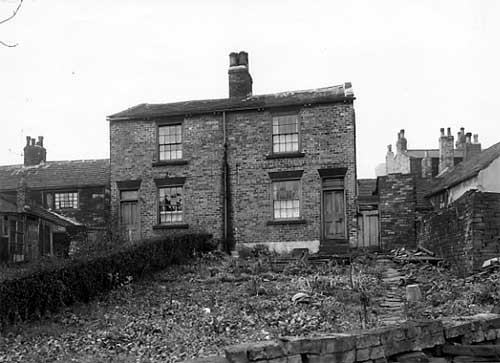 . .
By the outbreak of the Second World
War in 1939, an 18 year old Harold was living with his widowed
mother at 18 Far Fold. He had already begun to put his education
to use, working as an industrial chemist at a local Fireclay Works.
Whether he walked or cycled to the nearby sites in Wortley and
Farnley or took the tram to the larger Leeds Fireclay Company
(LEFCO) works in Burmantofts, Harold was part of the vital industrial
backbone of Leeds.
Harold's education at West Leeds Boys'
High School provided the foundations in mathematics and science
essential for his future as a navigator in the Royal Air Force.
As the war intensified, he transitioned from a civilian chemist
in Armley to an RAF airman, enlisting for flight duties. By the
age of 21, in 1943, he had attained the rank of Sergeant (Navigator/Wireless
Operator)-a role of immense responsibility. The precise technical
knowledge and navigation skills required for such a position were
undoubtedly honed during his formative years at WLBHS , transforming
a gifted student into a key member of a combat aircrew in No.
143 Squadron, RAF Coastal Command
|
Coastal Command 1943
- North Coates Strike Wing
The North Coates Strike Wing was formed in
late 1942 as part of RAF Coastal Command’s effort to disrupt
the increasingly well-defended German convoys operating in the
North Sea. Carrying iron ore, timber, fuel, and military supplies,
these convoys were vital to the German war economy and were shielded
by layers of Flak-armed trawlers, minesweepers, and Vorpostenboote,
making them exceptionally dangerous targets.
By 1943, Harold had joined Coastal Command during the creation
of its first dedicated Strike Wing at North Coates, Lincolnshire.
This elite formation—comprising Nos. 236, 254, and 143 Squadrons—flew
the formidable Bristol Beaufighter and undertook some of the most
daring operations of the war: low-level attacks against heavily
defended shipping in the North Sea.
Harold flew the standard Bristol Beaufighter as a member of 143
“Gamecock” Squadron. The aircraft carried four 20 mm
Hispano Mk II or Mk III cannon in the lower fuselage,
supported by six .303-inch Browning machine guns in the wings.
143 Squadron’s role was flak suppression—neutralising
the escorts’ anti-aircraft guns long enough for torpedo aircraft
to make their runs. Cannon-armed Beaufighters, including JL892,
swept in at mast height, raking escort vessels with 20 mm
fire. Their targets included Vorpostenboote and minesweepers,
which mounted the heaviest Flak. This phase of the attack was
always the most perilous: the escorts were already alert from
earlier sightings, and the open sea offered almost no cover.
|
"Torbeau" Beaufighter equipped for the torpedo
role . Note the cannon ports under the nose of the aircraft. |
 |
  Life
as a Beaufighter Navigator / Wireless Operator in a Strike Wing
was brutal and physically demanding.
While the pilot focused on the target, Harold's role was to guide
the aircraft to the convoy through a wall of anti aircraft fire
while skimming the waves at mast height to avoid radar and enemy
guns. His world was a map table lit by a small lamp, the hiss
of radio static, the ticking of instruments, and the trust of
the man flying the aircraft. In the chaos of a low level strike,
his calm precision was as vital as any weapon. He was the voice
in the pilot's ear, the mind calculating bearings at sea level,
the one who kept the aircraft connected to the world beyond the
roar of engines. Life
as a Beaufighter Navigator / Wireless Operator in a Strike Wing
was brutal and physically demanding.
While the pilot focused on the target, Harold's role was to guide
the aircraft to the convoy through a wall of anti aircraft fire
while skimming the waves at mast height to avoid radar and enemy
guns. His world was a map table lit by a small lamp, the hiss
of radio static, the ticking of instruments, and the trust of
the man flying the aircraft. In the chaos of a low level strike,
his calm precision was as vital as any weapon. He was the voice
in the pilot's ear, the mind calculating bearings at sea level,
the one who kept the aircraft connected to the world beyond the
roar of engines.
The environment was deafening and chaotic; the navigator worked
in a cockpit that vibrated violently from the recoil of four 20mm
cannons firing directly beneath him. It was a world away from
the quiet laboratories of the Leeds Fireclay Works-a transition
that required immense bravery and the peak of the technical skills
Harold had first learned at West Leeds.
Internal and external views of the navigator w/ops
cockpit in a Beaufighter
|
 A
Wing strike was a fast and furious battle fought at close
quarters between the attacking aircrew and the defending naval
gunners.The action would be over in minutes, leaving ships sinking,
damaged or on fire,and any Beaufighters that were hit either exploding,
crashng into the wavesor limping away damaged. Film footage of
Wing strikes, captured by by gun-mounted cameras revealed the
speed and intensity of the encounters and the wall of fire faced
on both sides, as well as the devastating effect of the Beaufighter's
cannon and rockets against the ships. A
Wing strike was a fast and furious battle fought at close
quarters between the attacking aircrew and the defending naval
gunners.The action would be over in minutes, leaving ships sinking,
damaged or on fire,and any Beaufighters that were hit either exploding,
crashng into the wavesor limping away damaged. Film footage of
Wing strikes, captured by by gun-mounted cameras revealed the
speed and intensity of the encounters and the wall of fire faced
on both sides, as well as the devastating effect of the Beaufighter's
cannon and rockets against the ships.
The Final Mission
Sergeant Harold Thompson served as Navigator and Wireless Operator
aboard Bristol Beaufighter Mark XIc JL892, the cannon armed variant
of the type. The aircraft carried the squadron code HO 'L' (for
Love) and belonged to No. 143 Squadron, part of the North Coates
Strike Wing of RAF Coastal Command.
On 29 April 1943, Harold and his "skipper" (pilot),
Flying Officer John Reginald Wilsdon, took off from RAF North
Coates at approximately 16.45 hours for an anti-shipping strike
off the northern coast of the Netherlands, near the West Frisian
Islands. Intelligence had reported a German led convoy in the
area, escorted by Kriegsmarine "Vorpostenboote" (armed
escorts) and minesweepers.
JL892 flew as part of a large strike force: of 5 other cannon
armed Beaufighters from 143 Squadron, 12 torpedo armed Beaufighters
of No. 254 Squadron, and 9 bomb armed Beaufighters of No. 236
Squadron.Together they mounted a coordinated attack using torpedoes,
cannon fire, rockets, and bombs against the convoy.
|
The battle that followed was intense.
Despite heavy defensive fire from the ships, the RAF strike succeeded
in sinking three vessels: the Swedish merchant ship SS Narvik
(4,251 BRT), the German cargo ship SS Aludra (formerly British
built, 4,930 BRT), and the German naval patrol vessel V.807 Auguste
Kämpf of the 7th Vorpostenflottille. However, the convoy's
anti aircraft guns took a severe toll on the attacking aircraft.
At least three Beaufighters were shot down during the engagement.
Among them was JL892, carrying Wilsdon and Thompson. Their aircraft
was seen to fall and "splash in the drink," as airmen
said, at approximately 18.07 hours (local time).
|
|

|
 |
 |
| Vorpostenboot (Armed trawler escort ) V810 similar to V807 "Auguste
Kampf" sunk in this attack |
SS Aludra
|
SS Narvik
|
|

Map showing loctation of the convoy attack North of the West Friesian
Islands, Holland.
|

A German Navy after-action sketch of the convoy attack showing
the 3 vessels sunk and RAF aircraft shot down , including JL892.
|
No Known Grave but the Sea
Tragically, neither Harold nor his "skipper"
(pilot), John Reginald Wilsdon, were recovered. While it is
possible their remains were washed ashore weeks after the crash,
they would then have been buried as "Unknown Airmen."
At the time, the RAF's red and green fibre ID tags were neither
fire nor seawater proof, often leaving those recovered from
the sea unidentified.
Because of the prevailing currents, drifting remains were typically
found eastward of the ditching site. A coastal cemetery or quiet
churchyard on a nearby island may hold their secret under a
headstone marked only by the RAF crest. It is far more likely
that these brave airmen found a only a sailor's grave. What
endures is their service, their courage, and the quiet grief
of families who never received the certainty of a final goodbye.
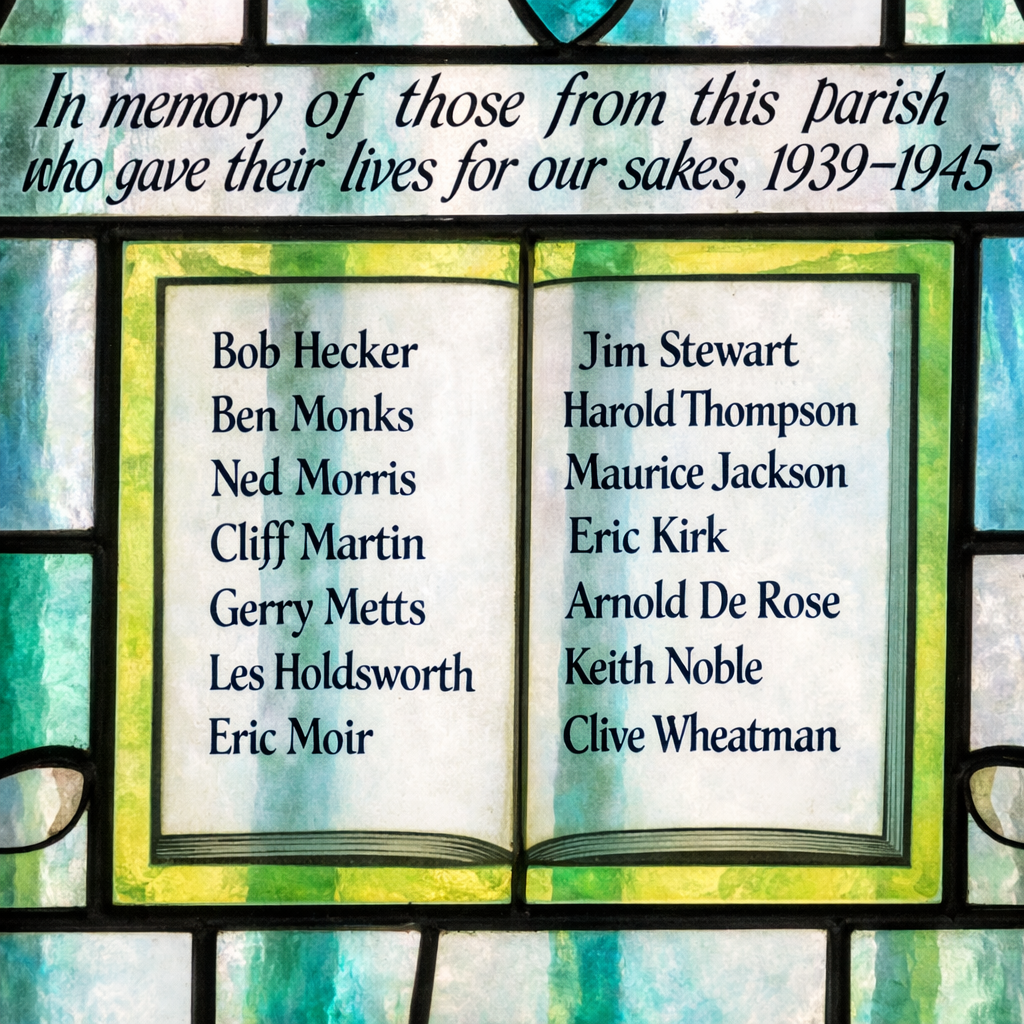
In addition to being named on the school's Second
World War memorial plaque, Harold is commemorated on one of
the six beautiful war memorial windows at Christ Church, Armley—poignantly,
the same church where his parents were married, he was baptised
and attended the Christ Church primary school.
|
 |
 |
|