|
School Dinners in the 1950s and 1960s
by Ellen Castellow
The first story is a general
article about school dinners in post-war Britain which I found online
I have added my own reminiscences
about school meals at WLBHS , from 1959 to '66. I am a bit hazy
about some of the details so if you want to add your own comments
or correct mine please contact me via the e-mail link.
|
School dinners… love them
or hate them they were an integral part of life for most children
in the 1950s and 1960s…
We all remember the smell of overcooked cabbage that haunted the halls
and corridors of our schools in the 1950s and 1960s. School dinners
- loved or loathed, they have left us with many memories!
If you lived within walking distance
of your school, and your mother or a neighbour was willing to make
you lunch, you could go home, rather than stay for school dinners,
returning in time for afternoon lessons.
Everyone else had school dinners. Dinner money was collected every
Monday for the week, a shilling a day in the late 1950s rising to
1s 6d in the mid 1960s. Free school meals were available to those
in need. |
 |
| Cooked from scratch on the
premises, these dinners were planned to give children a hot, nutritious
meal in the middle of the day. In the 1950s and 1960s many a child
lived in poverty and a hot meal was often not possible. School milk
had also been introduced to improve the poor diet of many children. |
Children sat at tables, sometimes
in the school hall that doubled as the gym. Often there was an adult
on each table who would coach the children in table manners, 'please
pass the salt' etc. as well as encouraging them to eat the less delicious
but still nutritious dishes on the menu. If no adult, then often a
prefect or older child would be 'head of table'.
Following rationing, which continued until 1953, this was plain cooking.
Weekly staples would include minced beef and carrots in gravy with
mashed potatoes, for example, or hotpot. Friday lunch was always fish,
often a piece of white fish in parsley sauce or fish and chips, and
in the 1960s, maybe fish fingers. Steak and kidney pie, liver and
onions, corned beef and toad in the hole also appeared frequently
on the menu and were accompanied by tinned peas or seasonal vegetables,
more often than not cabbage that had been boiled into a soggy mush.
In the summer there might be ham salad, consisting of a slice of ham,
round lettuce, cucumber and half a tomato, served with boiled potatoes. |
 |
|
You were generally expected to eat everything
on the plate, even if that meant the dinner lady or teacher keeping
you behind until you had finished the now cold, congealed plate
of food in front of you. Many have been permanently scarred by the
experience! It was best to chew quickly, swallow hard and flush
down with a glass of water.
For around the 50% of children who stayed
school dinners in the 1950s, it was the main meal of the day. Whether
you remember them fondly or not, nutritionally these were balanced
meals: a main course of protein, vegetables and carbohydrates, with
puddings either made with milk or served with milky custard. Prepared
from fresh each day, there were no artificial additives. [e-numbers
had yet to be invented ]
Whilst the plainly cooked main courses and overcooked cabbage may
have filled many with dread, the vast majority remember the puddings
with great affection. Chocolate sponge pudding with chocolate custard,
for example - nectar of the gods.
|
 |
Puddings
were the saving grace of school dinners. Sponge puddings were served
with hot custard, usually yellow in colour but not always; sometimes
there was green custard or pink. The school dinner ladies must have
made gallons of custard; if not homemade (and invariably lumpy) it
was made from Bird's custard powder mixed with milk.
Suet puddings such as spotted dick and jam roly poly were tasty and
filling, perfect for those who had struggled through a less than appetising
first course. Prunes and custard kept the children 'regular': it was
fun to count the prune stones with the rhyme, "Tinker, tailor,
soldier, sailor…". Apple crumble and apple pie were always
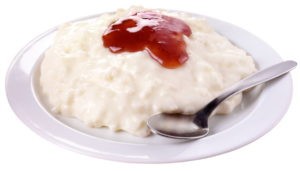
popular. And then there were the milk puddings: blancmange or rice
pudding, tapioca or sago ("frogspawn"), usually served with
a spoonful of jam. |
 |
|
OK you 've had the starter
now for the main course !
My recollections of School Dinners at West Leeds.
- John Swash
|
|
We always knew them
as dinners, even though they were eaten at lunchtime. The word lunch
sounded far too insubstantial or "airy Fairy". In most
Leeds households of the 1960s, meals were breakfast, dinner, tea,
and supper - with the possible exception of Harewood House, where
they may well have said luncheon.
I first encountered the delights of LEA school
dinners in my final year at Brownhills Junior School in Harehills.
Our meals were served in the neighbouring Methodist church hall
on Harehills Lane, and the fare was much as described in the earlier
article — hearty, simple, and unmistakably of its time.
The dining experience at WLBHS differed in several respects. The
"dinner hut" (dining hall. or refectory), stood apart
from the main redbrick building in a concrete structure that probably
dated from the 1940s. It had seating for only about half the school,
so dinner was served in two sittings. I believe, though I can’t
say for certain, that the food was delivered from a central kitchen
elsewhere, as there seemed to be very little actual cooking done
on site.[1] I don't remember queuing to be served by the dinner
ladies at a serving hatch . I think the food was delivered to our
tables on a trolley and we served ourselves from the large metal
containers and jugs.
|
School dinners were a sea
of potatoes, pastry, and bread. We never saw rice (except in rice
pudding), and pasta rarely ventured beyond macaroni cheese - it was
the 1960s, after all. Stodge ruled. Thick suet sponge over a rich
layer of steak and kidney; thick slabs of jam sponge, sprinkled with
desiccated coconut and drowned in custard- these were just some of
the ways they filled us up.
Meals were unapologetically high in calories. Stodge was considered
essential. Every pie had more crust than filling, and every crumble
had a thicker topping than fruit, but that suited this hungry boy
perfectly.
Bad days were rare, but unforgettable.
The worst was liver with a greenish hue and flavour that rendered
it inedible to me and the dreaded sago, universally known as "frog
spawn". Gooseberry pie for desert divided opinion, but it was
- and remains - one of my favourites, with its sugar-dusted pastry
and layer of sweet-sour filling.
|
|
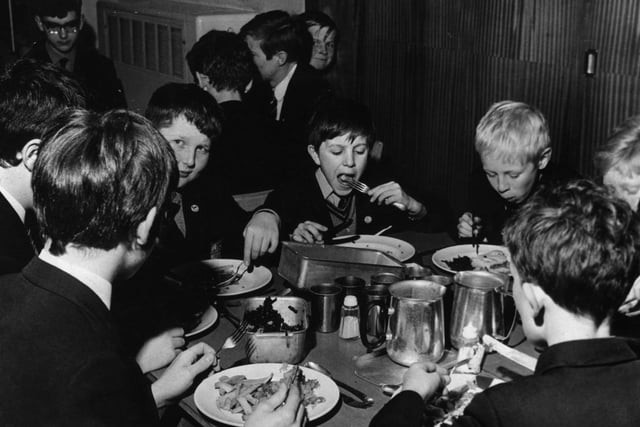
This
photo is pretty much how I remember school dinners at WLBHS. Eight
of us on a table, seated on benches often with a teacher at the
head of the table to keep order. No table cloth - just wipe clean
Formica. Table manners weren't too bad, just the occasional flicking
of peas with a spoon at another table when the teacher was otherwise
engaged.
Food was served in metal baking tins and
metal
jugs for gravy and custard. Nothing to drink except good old Leeds
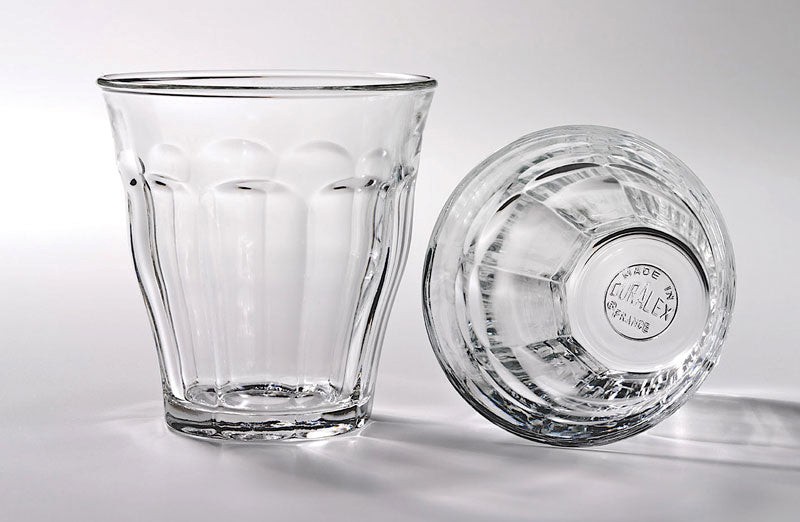
tap water from a jug. For some reason the drinking glasses were
always the same with a "Duralex - Made in France" logo.
I noticed this in primary school and it was the same at WLBHS .
I always wondered why the LEA bought its glassware from a French
manufacturer.[2}
To ensure that puddings served in the metal tins were divided fairly
between eight
of us, the person who cut the pudding in the tin always got the
last slice. As
for the custard, those metal jugs were notorious for heat loss,
which accelerated the formation of that thick "skin" on
the surface. While most of us found it off-putting, luckily every
table seemed to have at least one designated "skin eater"
who treated it like a delicacy.
"The
aspect of school custard I liked best was its thinness. Like powdery
water. My wife thinks I’m mad when it comes to my custard preferences."(RP)
|
 |
|
[1] As I suspected, many UK Local Education Authorities
(LEAs), including Leeds, used to rely on central kitchens, often
called production or catering units, to cook school meals in bulk.
The food was prepared in one place, packed into insulated containers,
and sent out to individual schools where it was simply served by
the dinner ladies. This approach which helped keep costs down and
standards consistent was common from the mid 20th century until
it was phased out in the 1990s. I remember seeing the collection
of the leftovers at my primary school. The slops were collected
in steel bins and used to feed pigs!
[2] The mystery
of the French glassware has a simple explanation: Duralex was the
industry standard because it used a tempering process that made
the glass virtually unbreakable. The Duralex Picardie and Gigogne
designs were chosen by Local Education Authorities (LEAs) across
the UK because they could survive being dropped on stone floors
or stacked aggressively by kitchen staff.
|
 |
|