|
Remember 1966 and all that?
The Year We Left School and the UK Changed
Forever, by John Swash
|
|
"The
past is a foreign country they did things differently there...."
|
Class of '66: Can you believe it has
been 60 years since we walked out of the school gates for the
last time in the summer of '66? What a time to be young and stepping
out into the world. It was a year of absolute highs and heartbreaking
lows, packed with massive cultural shifts, political drama, and some
of the best music ever made. Click
here to see 1966 class photos
Let's take a look back at the incredible moments, people, and changes
that shaped the remarkable year we left WLBHS. |
Spring: Elections, Courtrooms,
and Global Shifts
Our final year kicked off with a massive
political shift. On 31st March, the UK went to the polls in a general
election. Harold Wilson led the Labour Party to a landslide victory,
securing a 96-seat majority with 364 seats and 48% of the vote. (
We followed the count throughout the next day in class , getting the
results on Peter Bramwell's "secret" tranny radio and marking
the results on a coloured map of UK constituencies.) This gave his
government a powerful mandate to push forward with major economic
and social reforms, giving rise to what the press constantly called
the "permissive society" to describe new laws on gambling,
censorship, and fashion.
Away from politics, the headlines that spring were gripping. In January,
Indira Gandhi was elected as India's first female Prime Minister.
Back home in May, the dark and harrowing Moors Murders trial concluded,
with Ian Brady and Myra Hindley sentenced to life in prison for the
murders of five children.
|
|
The "White
Heat" of British Technology
 The
physical and technological landscape of Britain was transforming
right before our eyes in 1966. Progress and modernisation were central
themes of the year, represented by pioneering infrastructure projects
and bold engineering leaps. The
physical and technological landscape of Britain was transforming
right before our eyes in 1966. Progress and modernisation were central
themes of the year, represented by pioneering infrastructure projects
and bold engineering leaps.
To aid the nation's growing telecommunications network, the Queen
officially opened the iconic Post Office Tower (later renamed the
BT Tower) in London. Transportation was also revolutionised as the
UK motorway network rapidly expanded, including major developments
to the M1, M4, M5. A crowning achievement of this new era of mobility
came when the Severn Bridge was officially opened, linking England
and Wales like never before.
Educational opportunities expanded with the transformation of former
Colleges of Advanced Technology (CATs) into new universities. Several
of our classmates were among the inaugural students at these institutions,
which included the universities of Salford and Bradford.
We were right in the "white heat of technology" in '66
a famous phrase coined by Harold Wilson's Labour government, with
Tony Benn leading the charge as Minister for Technology. You could
feel the country modernising everywhere: the expanding motorway
networks like the M4 and M5, the development of Concorde, steam
locomotives being replaced by diesel and electric, the expansion
of nuclear power, and the development of the Hovercraft and the
Hawker Harrier, the world's first vertical take off jet-fighter,
to name but a few. (I remember
two of our fellow 6th formers, Chris Hawkins and Richard Newton,
even made a large scale model
of Concorde
for a talk to the school science club that year). More
mundanely , the
first Credit card was introduced in the UK with the launch of Barclaycard
on Jun 29th '66 followed a
year later by
the first ATM - technology which affected all our daily lives.
|
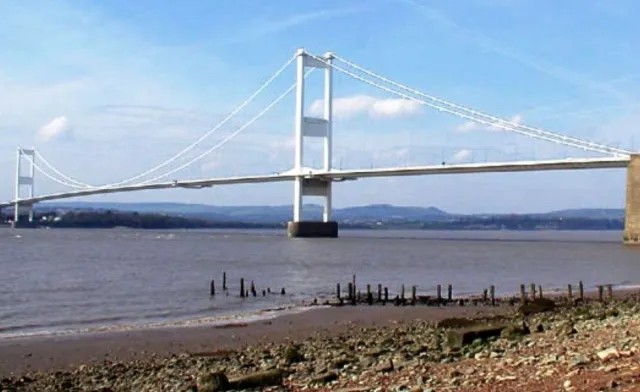
The
original Severn Bridge was
officially opened by Queen Elizabeth II on September 8, 1966.
|
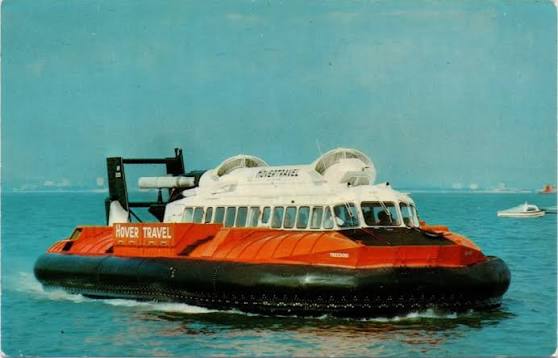
The Hovercraft
ferry service to the IOW was inaaugurated in 1965 and the cross
chanel service using the world's largest civil Hovercraft SRN-4
started in 1968. (In
1971 I took the much bigger cross channel SRN4 Hovercraft , Princess
Margaret, which carried 250 passengers and 30 cars and could do
the trip in only 30 min. On the day I travelled it was rough and
you were lucky if you could get the duty free drink the stewardess
poured you , strapped into your airline style seat, to your lips
before it hit the ceiling.-JS)
|
Summer: Leaving School and Stepping
Into the World
I skipped the last few days at school to set off on a youth hostelling
trip to Germany with a couple of classmates (Graham and Wally). The
only thing I remember about my actual last day at WLBHS was playing
football on the rugby field next to Heights Lane. That was the only
occasion I played soccer on the school premises.
Travel was different back then After paying for my British Visitors
Passport , valid for 1 year, and passport photo, I was allowed the
grand sum of £50 in foreign currency-which was the absolute
maximum allowed under the strict exchange control regulations at the
time. The amount had to be physically written directly into your passport!
The journey itself was an adventure. We travelled by train to London
and stayed at the Holland Park Youth Hostel, where we met up with
the rest of our Ramblers group. From there, we took the train to Dover,
caught the cross-Channel ferry, and then got a train to Brussels.
After overnighting at the Brussels Youth Hostel, we travelled onward
via Aachen to Cologne. Interestingly, despite all the talk of modernisation,
all of those trains on the continent were still steam-hauled!
|
|
The Soundtrack of the Summer of '66
The soundtracks to our post-school freedom
dominated the airwaves with an incredible mix of British Invasion
rock and rising pop hits:
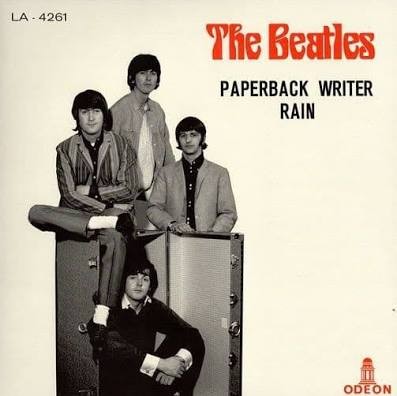
" The Beatles topped the charts with Paperback Writer,
Yellow Submarine, and Eleanor Rigby, right around the time
John Lennon sparked a global outcry by claiming, "We're more
popular than Jesus now."
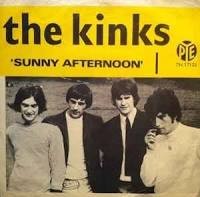
" The Kinks gave us the quintessential summer anthem,
Sunny Afternoon.
" The Troggs shook things up with Wild Thing (hitting
#2) and With a Girl Like You (hitting #1).
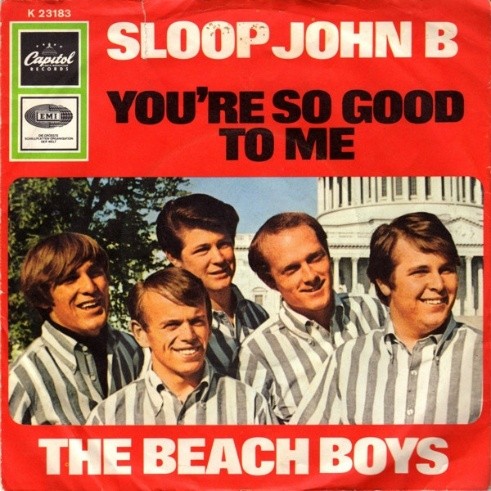
" The Beach Boys brought us God Only Knows
and Sloop John B.
" The Mindbenders popularised our favourite new adjective
with A Groovy Kind of Love, while The Monkees took
over late summer with I'm a Believer.
"Pop music turned out to be the ultimate icebreaker for
us abroad. We met some German girls who spoke English well, but
they were absolutely desperate to understand the meaning of British
pop lyrics-especially the recent Beatles release, Paperback Writer!"
|
 |
  |
|
Fashion and Youth Culture in 1966 Britain
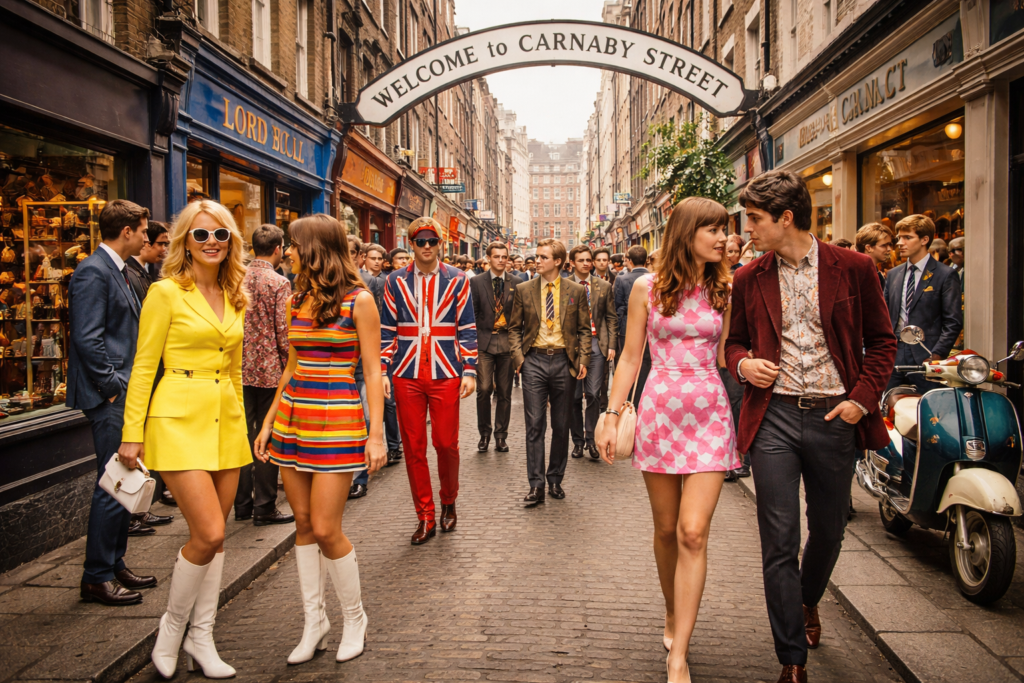
By the time we left school that summer,
youth culture was firmly in the driving seat, and we were right
in the middle of it. London's Carnaby Street and the King's Road
were the absolute centres of the universe, setting the trend for
how Britain dressed. Mod styles were everywhere, defined by bold
geometric patterns, strong colour palettes, and the iconic mini-skirt.
The Kinks even gave us a name for it in their hit song: "The
dedicated follower of fashion." Fashion in 1966 reflected the
confidence and creativity of the Swinging Sixties.
Youth culture continued to set the pace, particularly in London.
Carnaby Street and the King's Road were firmly established as trendsetting
centres, shaping how Britain dressed and how it was seen around
the world.
The Way we Were!
|
|
The World
Cup Final: A View from Germany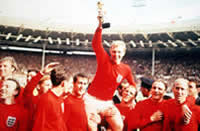
Then came Saturday, 30th July-the greatest
moment of collective celebration in British sporting history. After
the Jules Rimet trophy was stolen and famously found in a garden
by a dog named Pickles, England made it to the final. Bobby Moore's
squad was in peak form, and their success was so legendary that
Moore was named BBC Sports Personality of the Year.
Because of our holiday, I only
saw the early stages of the World Cup before we left Leeds. We actually
managed to watch the final in a tiny village pub in Germany. We
could hear a television on inside, so we walked into what looked
like an empty pub. When we stepped into the television room, we
suddenly realized we had stumbled straight into the landlord's private
living quarters! He had a group of family and friends glued to the
set. However, they made us incredibly welcome and invited us to
sit down and watch the match with them. The commentary was, of course,
entirely "auf Deutsch"!
In front of a roaring Wembley crowd back home, England defeated
West Germany 4-2. Who could forget Kenneth Wolstenholme's legendary
commentary as Geoff Hurst scored the final goal: "They
think it's all over... it is now!" Tickets were so
easy to get back then you could buy them at local newsagents, with
standing room costing just 10 shillings (50p) and the best seats
priced at £3 15s (£3.75). Compare that to the 2026 World
Cup final in New Jersey, where FIFA's top-tier seats skyrocketed
to a staggering $32,970 (£24,200)! Needless to say I'll
be watching it on TV again, but at least its in colour now . We
only had B&W TV back then.
|
|
The Cost of Living
Economic pressures were never far from
public attention. In October 1966, unemployment stood at 437,229.
The average annual salary was just £850
pa , and average weekly household income in early 1966 recorded
at £24 2s 11d
Here is what it cost us to live back then, put into proper shillings
and pence:
• A loaf of bread (800g): Cost us 1s 9d (9p) - today it's around
£1.45.
• A pint of milk: A tiny 9d (4p) - today it's about 85p.
• A dozen eggs: Only 1s 5d (7p) - today it's roughly £2.80.
• A litre of petrol: Just 1s (5p) to fill up the tank - today
it's around £1.55.
• A pint of bitter down the local: A brilliant 3s (15p) - today
it's averaging a hefty £5.20.
|
|
The 1966 Travel Experience
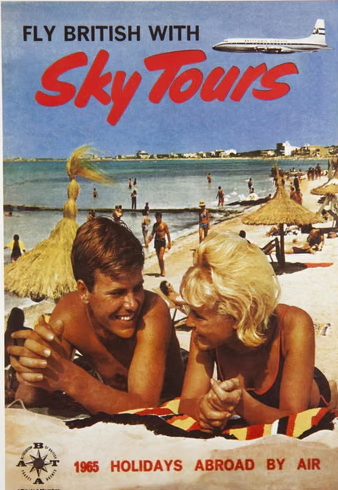 In
1966, the British package holiday to Spain boomed, characterized
by formal travel attire, propeller flights, and stays in newly built
Costa Brava or Majorca resorts. These early trips established the
modern tradition of affordable Mediterranean getaways for UK tourists. In
1966, the British package holiday to Spain boomed, characterized
by formal travel attire, propeller flights, and stays in newly built
Costa Brava or Majorca resorts. These early trips established the
modern tradition of affordable Mediterranean getaways for UK tourists.
The chances are you would have booked your
holiday with one of the long forgotten travel companies , such as
Lunn Poly or Clarksons and flown with Dan Air in one of their turboprop
airliners such as the Elizabethan or Airspeed Ambassador. They flew
you to Perpignan for a holiday on the Costa Brava.
Travel Style: Air travel was a novelty. Passengers on charter
airlines flew in government-surplus planes or early jets, often
wearing suits, ties, and dressesfor the journey.
The Destination: Fast-developing resorts
like Torremolinos, Benidorm, and Magaluf rapidly transformed from
quiet fishing villages into bustling, high-rise sun destinations.
The Cost: A two-week trip with flight
and full board cost about £76. While this cash price sounds
low, it actually required nearly four weeks of the average worker's
wages, whereas a modern one-week holiday requires just one week
of average earnings. Despite decades of inflation, foreign travel
has become significantly cheaper and far more accessible to the
public. This largely due to the lifting of historical travel regulations.
In the 1960s, package deals were legally prevented from undercutting
standard scheduled return flights operated by the state owned carriers
like BEA. Hen parties in Benidorm and Stag do's in Prague were
undreamt of back then.
The Currency Limit:
Because of an economic crisis in 1966, the UK government restricted
the amount of foreign currency tourists could take out of the country
to £50 per person.
Culture shock: Spain was certainly
different then, still a fascist dictatorship ruled by General Franco,
as I found out when I was given a "friendly" jab in the
ribs with a sub-machine gun carried by a Guardia Civil for stepping
across a line in a queue at the French border. In villages people
still used donkeys and scooters for transport. The mayer of Benidorm
once rode on his Vespa scooter to Madrid for a meeting with Franco!
|
|
Motoring
There were roughly 7.7 million
cars on the road in 1966.compared to about 35.5 million driving
on UK roads in 2026
If you were lucky enough to buy your first car after leaving school,
a brand-new standard Mk I Morris Mini-Minor cost approximately £500,
while the high-performance 1275 cc Mini Cooper S would run you about
£756. Today, a new entry-level MINI Cooper 3-Door Hatchback
starts around £25,265! At seventeen, a driving licence was
within our reach, yet cars remained a rarity in the pupils car park.
A notable exception was a prefect from the year above who occasionally
rolled up in a flashy red E-Type Jaguar—his family ran a dealership
in Bradford. One of my class mates
often had the use of his mother's pale blue Hillman Imp with its
novel rear water-cooled aluminium engine. Occasionally he gave some
of us a lift home to Bramley. For the rest of us, two
wheels were the norm. Motorbikes and scooters dominated the school
gates. BSA Bantams were the favourite since learners were restricted
to 150cc, and army surplus or ex-GPO telegram delivery bikes could
be snapped up for a song. Naturally, the mods in our ranks made
their entrance on stylish Vespas and Lambrettas.
|
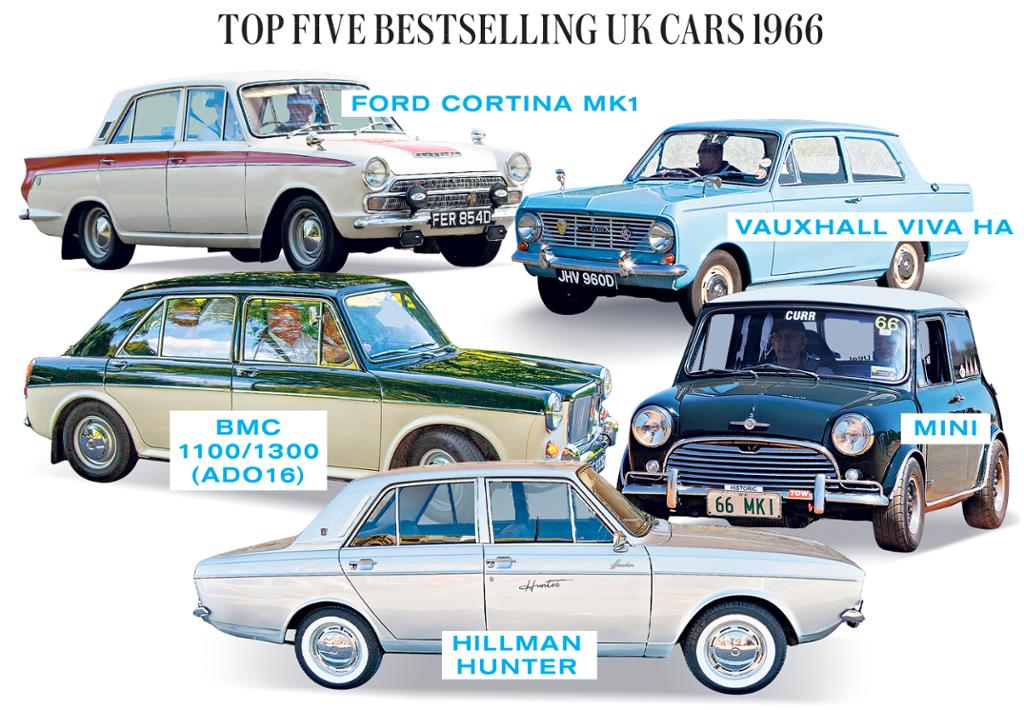 Cars
from different manufacturers were more distinctive back then.. Cars
from different manufacturers were more distinctive back then..
|
|
Autumn: Global Tensions and Deep National Sorrow
As the summer highs faded into autumn,
the world beyond our borders moved fast, and the Cold War remained
a powerful backdrop to daily life. In the space race, the US achieved
the first orbital docking with Gemini 8, while the Soviet Union
landed Luna 9 on the moon and sent Luna 10 to orbit it. Tensions
also flared on 17th January when a US B-52 bomber collided with
a tanker over Spain, accidentally dropping four hydrogen bombs in
the famous "Palomares incident"-the most serious "Broken
Arrow" nuclear accident in history.
Closer to home, public opinion grew much louder. Anti-Vietnam War
protests regularly filled the streets of London. We watched crowds
outside the US Embassy in Grosvenor Square chanting at US President
Lyndon B. Johnson: "Hey, Hey, LBJ, how many kids did you kill
today?" while Johnson used his speeches to promote his domestic
"Great Society" agenda.
Further away, Chairman Mao launched the Cultural Revolution in China,
proclaiming it "a great revolution that touches people to their
very souls". I still remember my friend Vic Ellis writing
off to the Chinese Embassy and receiving a copy of Chairman Mao's
Little Red Book in English, which he proudly carried around in his
blazer pocket!
|
|
Winter: Looking Back at a Remarkable Year
As the year drew to a close, we wrapped
up 1966 with Tom Jones topping the charts with the year's best-seller,
Green, Green Grass of Home, while Jim Reeves' Distant Drums held
the record for the longest run at number one with five weeks.
Six decades later, 1966 stands out as a year of massive contrasts.
It was a time of immense optimism mixed with economic uncertainty,
where unemployment saw a sharp jump of 100,000 in October.
For our class, these aren't just pages in a history book. Whether
we were listening to the catchphrases of "Round the Horne",
watching the debut of Star Trek and Batman on TV , or going to the
cinema to see Michael Caine in Alfie, these are our shared memories.
It was the unforgettable year that we stepped out into the world
and watched history unfold in real-time.
|
|
What are your memories?
CONTACT
ME
Click here to
see 1966 class photos
|
|